
• Skip to main content
  • Skip to secondary menu
  • Skip to primary sidebar
  • Skip to footer
AFRIPOL

AFRIPOL

  • Home
  • About Us
  • Mission Statement
  • Articles
  • Book Review
  • Archive
  • Contact Us

World Oldest Wooden Structure of 476,000 years Unearthed in Zambia, Africa

October 17, 2023 by AFRIPOL Leave a Comment

 by Enrico de Lazaro  SCI NEWS

Archaeologists have found an ancient wooden structure at the archaeological site of Kalambo Falls  in Zambia. This structure — dated to about 476,000 years ago — has no known parallels in the African or Eurasian Paleolithic and may represent the earliest use of wood in construction.

Wooden artifacts rarely survive from the Early Paleolithic as they require exceptional conditions for preservation. Therefore, archaeologists have limited information about when and how hominins used this basic raw material or how Paleolithic humans structured their environments.

“Our find has changed how I think about our early ancestors,” said University of Liverpool’s Professor Larry Barham.

“Forget the label ‘Stone Age,’ look at what these people were doing: they made something new, and large, from wood.”

“They used their intelligence, imagination, and skills to create something they’d never seen before, something that had never previously existed.”

“They transformed their surroundings to make life easier, even if it was only by making a platform to sit on by the river to do their daily chores. These folks were more like us than we thought.”
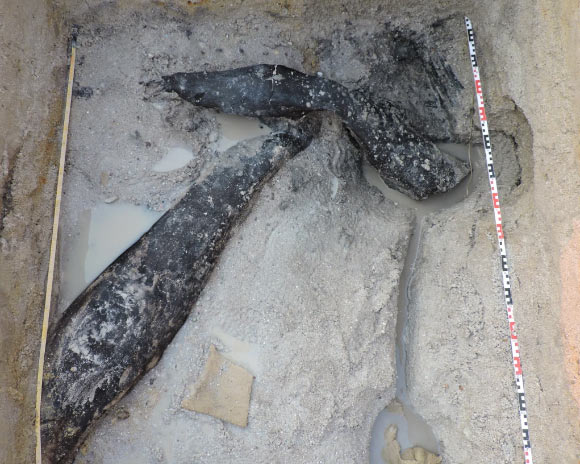
The 476,000-year-old structural unit formed by two overlapping logs. Image credit: Barham et al., doi: 10.1038/s41586-023-06557-9.

Professor Barham and colleagues discovered an ancient wooden structure at the archaeological site of Kalambo Falls, which lies above a 235-m (772-foot) waterfall on the border of Zambia with the Rukwa Region of Tanzania at the edge of Lake Tanganyika.

The structure includes two preserved interlocking logs joined transversely by an intentionally cut notch. The upper log had been shaped, and tool marks were found on both logs. The logs could have been used to construct a raised platform, walkway or foundation for dwellings in the periodically wet floodplain.

“This discovery challenges the prevailing view that Stone Age humans were nomadic,” the researchers said.“At Kalambo Falls these humans not only had a perennial source of water, but the forest around them provided enough food to enable them to settle and make structures.”

They used new luminescence dating techniques, which reveal the last time minerals in the sand surrounding the finds were exposed to sunlight, to determine their age.

“At this great age, putting a date on finds is very challenging and we used luminescence dating to do this,” said Aberystwyth University’s Professor Geoff Duller.

“These new dating methods have far reaching implications — allowing us to date much further back in time, to piece together sites that give us a glimpse into human evolution.”

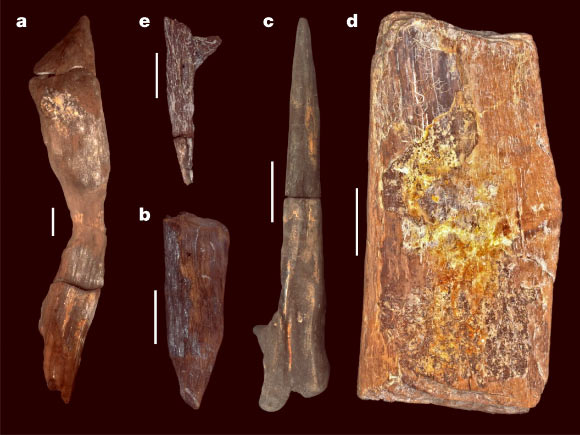
At Kalambo, the scientists also recovered four wood tools from 390,000 to 324,000 years ago, including a wedge, digging stick, cut log and notched branch.

“The finds show an unexpected early diversity of forms and the capacity to shape tree trunks into large combined structures,” the authors concluded.

“These new data not only extend the age range of woodworking in Africa but expand our understanding of the technical cognition of early hominins, forcing re-examination of the use of trees in the history of technology.”

Filed Under: Articles, Featured, Strategic Research & Analysis

Reader Interactions

Leave a Reply Cancel reply

Your email address will not be published. Required fields are marked *

Primary Sidebar

More to See

LifeTime Grammy for ‘King of Afrobeat’ Fela Kuti

February 2, 2026 By AFRIPOL

SHABOOZEY (Obinna Chibueze): First Nigerian American and African to win Country Music Grammy Award (see video)

February 2, 2026 By AFRIPOL

RSS AllAfrica News: Latest

  • Zimbabwe: Could Zimbabwe's Constitutional Changes Take It Back to the Mugabe Era?
    [RFI] Zimbabwe could be pushed back towards a one-party state under proposed constitutional changes that would extend President Emmerson Mnangagwa's rule and reshape how leaders are chosen - a move that critics say will weaken key democratic checks.
  • Djibouti: Djibouti's Guelleh Extends 27-Year Rule With Landslide Re-Election Win
    [RFI] Djibouti's long-serving president, Ismael Omar Guelleh, has secured another term in office after winning 97.8 percent of the vote, according to state broadcaster Radio Television Djibouti. The result grants him a sixth mandate and extends a rule that has now spanned 27 years in the strategically important East African nation.
  • Africa: A Failed U.S. Attempt to Opt Out of Democracy Talk
    [CFR] When Washington chooses not to comment on democracy, authoritarians and their backers fill in the silence.
  • Sudan: Three Years of War in Sudan Have Shattered Water and Health Services: UN
    [allAfrica] Geneva -- Three years of war in Sudan have shattered essential services like water and health, and plunged the country into the largest humanitarian crisis in the world, the country's World Health Organisation (WHO) representative says.
  • Nigeria: 61 Bodies Recovered After Niger Attack
    [Premium Times] Residents said the corpses were retrieved from surrounding bushes days after the abduction of the victims
  • Uganda: UPDF Hosts U.S. Army War College Delegation On Military Transformation, Regional Security
    [Nile Post] The Uganda Peoples' Defence Forces has hosted a delegation from the United States Army War College in a high-level engagement focused on military transformation, regional security, and defence cooperation.

Tags

Achebe Africa Anambra Boko Haram Buhari CBN Corona Virus Egypt Igbo IMF Inflation Jonathan Kenya Nigeria Okonjo Iweala Peter Obi Sanusi Senate Soludo South Africa Soyinka United States
  • Facebook
  • Instagram
  • Twitter
  • YouTube

Archives

Footer

Africa Political and Economic Strategic Center, AFRIPOL is foremost a public policy center whose fundamental objective is to broaden the parameters of public policy debates in Africa. To advocate, promote and encourage free enterprise, democracy, sustainable green environment, human rights, conflict resolutions, transparency and probity in Africa.

Recent

  • Ifeanyi Umunna, Nigerian American Elected President of Harvard Law Student Government
  • Onitsha Needs and Deserves Environmental Facelift
  • Igbo Metallurgy Civilization was the oldest
  • South East students Sweep the Nigeria 23rd Annual National Mathematics Competition
  • Will Smith dancing In Angola in Africa (video)

Search

Tags

Achebe Africa Anambra Boko Haram Buhari CBN Corona Virus Egypt Igbo IMF Inflation Jonathan Kenya Nigeria Okonjo Iweala Peter Obi Sanusi Senate Soludo South Africa Soyinka United States

Copyright © 2026 · AFRIPOL