
For Afro-Panamanians, October offers a chance to celebrate Catholicism and their Blackness
By Shannon Sims Smithsonia
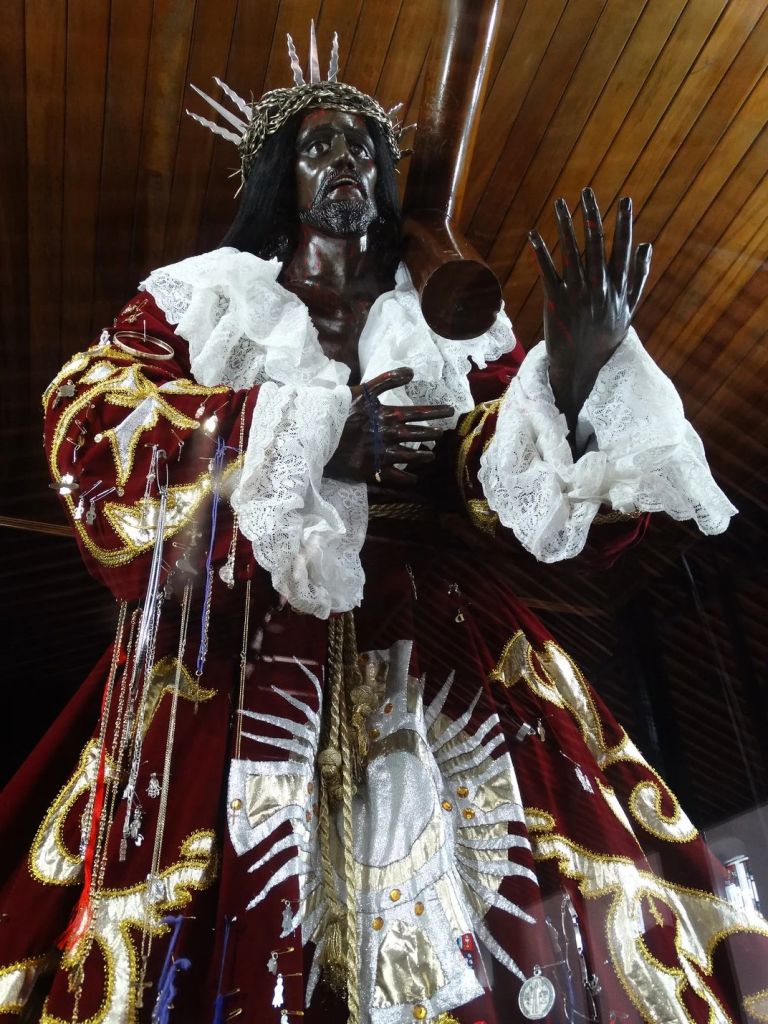
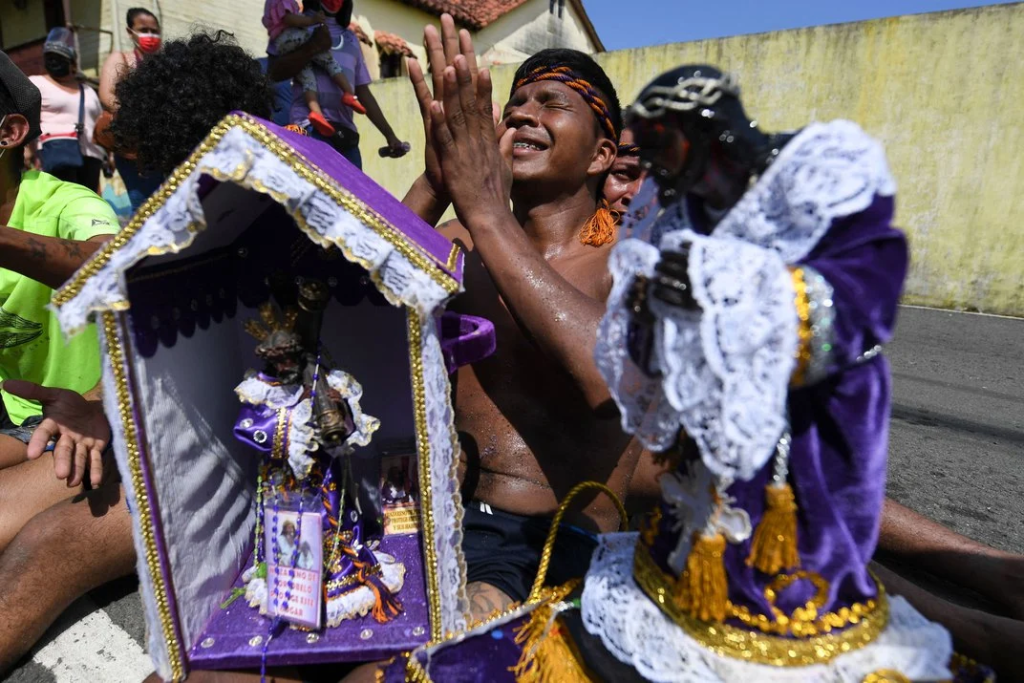
For three days each October, 26-year-old Evelyn Guerra treks 50 miles up and down jungled hills, until she reaches the Caribbean town of Portobelo, Panama, and the Festival del Cristo Negro. Along with several changes of clothes for the route’s rain and dirt, she brings a special treasure: a shoebox-sized, plexiglass diorama lined in Christmas lights she hand-glued around the edges, inside of which is a figure of a Black Jesus Christ. It’s a homemade, miniature version of the eight-foot-tall statue known as El Nazareno she, her father and thousands of faithful are traveling to see.
This year, on October 21, some 60,000 pilgrims will descend on the town to celebrate not only their Catholic religion, but also their Afro-Panamanian identity.
“The festival is more than a religious celebration,” writes theologian S. Kyle Johnson in a piece published by The Conversation in 2019. “It is a form of protest against Spanish colonialism, which brought with it slavery and racism.”
Other communities throughout Central America and Mexico host venerations to a Black Christ, and “such festivals play a crucial role for historically oppressed peoples,” Johnson writes, as a protest against the image of a raceless or white Jesus.
More than one-third of Panama’s gene pool is of African origin, and today nearly one in four citizens identifies as Afro-Panamanian, according to the country’s National Institute of Statistics and Census. The data suggest that more and more Panamanians are embracing their roots: the number of those identifying as Afro-Panamanian increased almost 200 percent over the past decade.
According to historian Kaysha Corinealdi, who researches Afro-Panamanian identity at Emerson College, the Festival del Cristo Negro is a humble way for everyday Panamanians to connect with their past. Her scholarly work maps how activism and community were used across the Americas to battle racism, marginalization and white supremacy, and she sees the festival as an outlet for that. In writing her new book Panama in Black: Afro-Caribbean World Making in the Twentieth Century, she says, “I wanted to ensure that readers learned about the activism of Afro-Panamanian teachers who advocated for the dreams and rights of younger generations.”
Spanish colonists first brought enslaved Africans to Panama in the early 1500s from the areas of modern-day Angola, Cameroon, Guinea-Bissau and the Congo basin. The enslaved laborers were set to work hauling goods over land across the isthmus as Spain sought to develop a shortcut to Peru in their race to beat Portugal in colonizing the Americas. By the mid-19th century, a new wave of future Afro-Panamanians arrived, as the massive Panama Railroad project attracted formerly enslaved people from other parts of the Caribbean with post-emancipation economic possibilities. Instead, many of the immigrants ended up in dangerous, low-paid positions on railroads or plantations—tens of thousands of them died. During the building of the Panama Canal, from 1904 to 1914, as many as 200,000 Caribbean migrants arrived in Panama, doubling the country’s total population at the time.
After the canal’s completion, around half of these migrants decided to stay, and by 1920 Afro-Caribbeans were the majority population in the Colon region, where Portobelo lies. Portobelo became a hub of Afro-Panamanian cultural demonstration.
According to Johnson, the Festival del Cristo Negro, as well as carnival celebrations in Colon around the time of Lent, call attention to the Catholic Church’s complicity in Spanish colonization and slavery. “Many Catholic leaders in the 16th to 18th centuries justified the enslavement of Africans and the colonization of the Americas, or at least did not object to it,” he writes.
Renée Alexander Craft, an artist and critical ethnographer at the University of North Carolina at Chapel Hill, wrote in When the Devil Knocks: The Congo Tradition and the Politics of Blackness in Twentieth-Century Panama that Black performance and Congo traditions in Panama illuminate “self-liberated Africans’ triumph over enslavement, their parody of the Spanish Crown and Catholic Church, their central values of communalism and self-determination, and their hard-won victories toward national inclusion and belonging.”
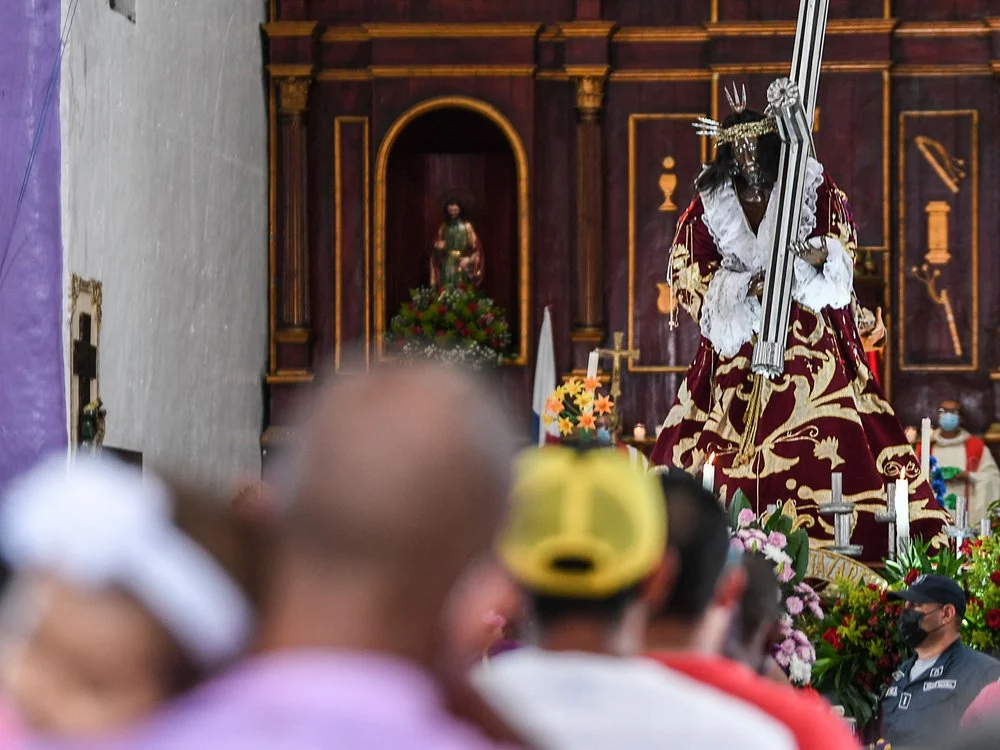
For centuries Portobelo’s Festival del Cristo Negro, which Corinealdi describes as a combination of pilgrimage and celebration, has served as an annual ritual to recognize and nurture Afro-Panamanian identity, and much of the occasion is centered on the El Nazareno statue. According to one legend, the life-size statue of the Black Jesus Christ was found floating in the ocean in the 1600s. Others claim it was built in 1814, at the same time as the Roman Catholic church where it has since resided: Portobelo’s Iglesia de San Felipe, better known as the Black Christ Church. Throughout the year, the faithful will dress the statue in gowns of different colors to refer to different seasons of the church. During the festival, El Nazareno is taken from the church and marched through the streets in a new robe, surrounded by thousands of followers.
That tradition was interrupted by the pandemic, and so 2022 will be the first time in two years that the festival happens. Milagro de la Cruz, one of the festival organizers, says she expects big attendance numbers this year since everyone is excited to get back to the custom—something in the ballpark of 200,000 visitors to little Portobelo (population: around 5,000) during the month of October.
During the festival, the streets fill with people joining together for processions into churches and around the town. Family groups often make coordinating shirts to match, which are emblazoned with the face of the Black Jesus Christ figure. This year, Evelyn Guerra’s family has designed purple ones that show a wooden image of Jesus against a galactic backdrop of stars. Purple, which denotes suffering in Catholicism, is a common color used during the festival to indicate the suffering of Jesus Christ and also of the Black people of Panama.
On the 21st, Guerra’s family members will gather as they arrive in Portobelo, get dressed, eat something, and then head to Iglesia de San Felipe. They spend about two hours in the church praying and singing, and then wander around town the rest of the day, witnessing the other ways that people demonstrate their faith. Some men crawl along the ground shirtless and enshackled, acting out the sorrow of the enslaved man or the sinner, as hot wax is dripped by others onto their backs. Others simply hold candles in silence or sway along to the sound of mournful trumpets. After a mass, at around eight o’clock at night, a vast procession out of the church and into Portobelo’s streets begins, and that’s when the Guerras will march with their encased diorama, called a nicho, and join others who have nichos of their own. They walk behind a large group of men with shaved heads who shuffle back and forth as they carry a float filled with lit candles surrounding the Christ statue. Those living in the apartments above the procession toss down confetti or flower petals over the crowds, and around midnight El Nazareno is returned to the altar.
For Guerra, the festival is an essential part of both her faith and her good fortune for the year: the last time she attended the festival she found out shortly after that she was pregnant after desperately trying for five years.
“For those of us that believe in God, this festival is our chance to give thanks for all of the blessings we receive. And for our survival as Afro-Panamanians through everything,” she says. “Attending this tradition is the least we can do.”
Leave a Reply