
• Skip to main content
  • Skip to secondary menu
  • Skip to primary sidebar
  • Skip to footer
AFRIPOL

AFRIPOL

  • Home
  • About Us
  • Mission Statement
  • Articles
  • Book Review
  • Archive
  • Contact Us

Nigeria Presidential Election failed to meet Nigerians’ expectations – U.S. Ambassador (US Mission)

March 7, 2023 by AFRIPOL Leave a Comment

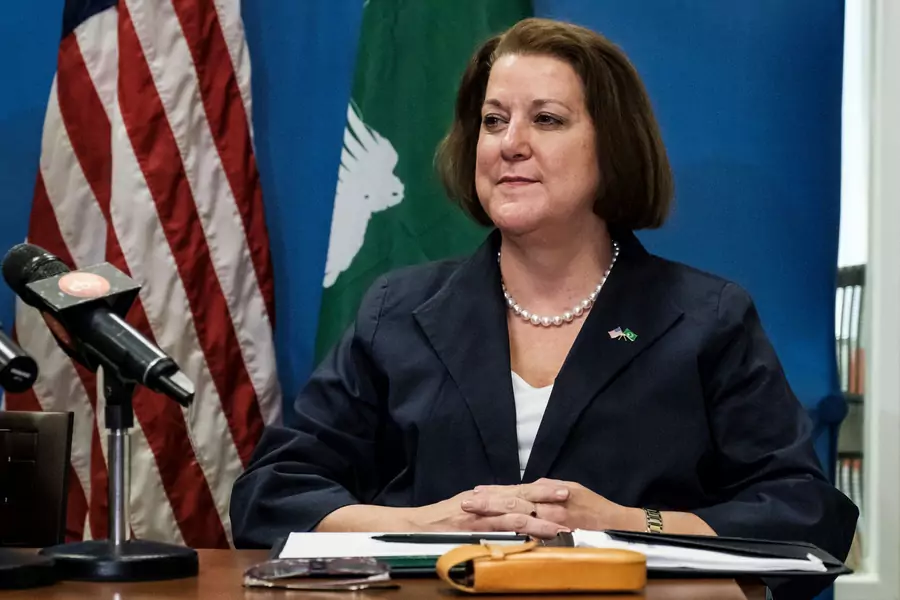
Mary Beth Leonard, U.S. Ambassador to the Federal Republic of Nigeria, issued a press release on Nigerian Election of 25th February on behalf of the U.S. Mission to Nigeria.

The press released stated that the election “failed to meet Nigerians’ expectations.” It has become apparent to U.S. Mission that Nigerians are not satisfied with the election process and outcome that was marred by irregularities, violence and rigging.

The statement said, “The Nigerian people have made clear their desire for responsive and inclusive governance, and we strongly support their ability to express that desire.  The United States and Nigeria are the two largest presidential democracies in the world, and longtime partners.  As Nigeria goes through these next weeks and months, we stand with you.”

Below is the press Release by United States Mission to Nigeria

The people of Nigeria demonstrated their dedication to democracy on February 25, but there are many angry and frustrated Nigerians as well as many who are celebrating victories they believe were hard-fought and well-earned.  In the coming days, it will be important for the future of this country that Nigerians not let their differences divide them, and that the legally established process for resolving challenges to the election be allowed to take its course.  We commend Mr. Obi and Mr. Abubakar for their recent statements committing to take this path, and Mr. Tinubu, who INEC declared the president-elect under Nigeria’s electoral framework, for acknowledging their right to do so.

The United States is no stranger to election-related controversy and conflict.   As much as it can be unsatisfying to end an electoral process in a courtroom, in a constitutional democracy bound by the rule of law, that is where electoral conflicts may appropriately conclude.

It is clear that the electoral process as a whole on February 25 failed to meet Nigerians’ expectations.  As I said numerous times prior to the elections, Nigeria has accomplished much in just the two-plus decades since the return to democracy, and a gradual improvement in the quality of its elections in that time constitutes one of those accomplishments.  We recognize that Nigerians want that positive trend to continue, including through the use of new technology intended to make the process of reporting results more transparent.  We thus reiterate our call on INEC to address promptly the challenges that can be resolved ahead of the March 11 gubernatorial elections, and to undertake a broader review of the problems that transpired during the last elections and what can be done to fix them.  In all cases, INEC should share with the Nigerian public information about the actions it is taking.

I also want to highlight some of the remarkable results from this past election that show how Nigeria’s political landscape is indisputably changing.  In more than half of the states – 20 – the winning candidate represented a different party than that of the incumbent governor.  Twelve of these states are led by APC governors.  For the first time, four presidential candidates won at least one state, and the top three each won 12 states based on these initial results.  In the National Assembly elections, even with results still incomplete, we already know that changes are afoot: seven sitting governors lost in their attempts to win election to the Assembly; the Labor Party has won at least seven seats in the Senate; the NNPP has won at least 11 seats in the House of Representatives.

The Nigerian people have made clear their desire for responsive and inclusive governance, and we strongly support their ability to express that desire.  The United States and Nigeria are the two largest presidential democracies in the world, and longtime partners.  As Nigeria goes through these next weeks and months, we stand with you.

Filed Under: Articles, Featured, Strategic Research & Analysis

Reader Interactions

Leave a Reply Cancel reply

Your email address will not be published. Required fields are marked *

Primary Sidebar

More to See

UN Chief speaks On the International Day of Remembrance of the Victims of Slavery (videos)

March 24, 2026 By AFRIPOL

President Cyril Ramaphosa’s Powerful Tribute to Jesse Jackson (video)

March 10, 2026 By AFRIPOL

RSS AllAfrica News: Latest

  • Africa: Rwanda and South Africa - From Diplomatic Frost to Strategic Partnership and Greater People-to-People Mobility
    [allAfrica] After more than a decade of diplomatic estrangement, Rwanda and South Africa appear to be taking meaningful steps toward rebuilding a relationship long marked by suspicion, political tensions, and missed opportunities. Recent high-level engagements between Kigali and Pretoria suggest a growing recognition that Africa's future is better served by cooperation than confrontation. As both […]
  • Tanzania: My Christian Father, My Muslim Mother, and My Country's Truth
    [allAfrica] My father is a devout Lutheran. My mother is a practicing Muslim. I was educated at a Catholic school. This is not an unusual story in Tanzania - it is a very ordinary one.
  • Ghana: Ghana Pip Panama in World Cup Opener... Team Arrives in Rhode Island Base to Prepare for England
    [Ghanaian Times] Caleb Yirenkyi bundled in the winning goal in the fifth minute of stoppage time, to send thousands of Ghanaians in Canada into a frenzy.
  • Nigeria: Retired Military Officers Warn Against Ethnicising Insecurity
    [Vanguard] Retired military officers and associates of the late Major General Rabe Abubakar have cautioned Nigerians against blaming the North for the country's worsening insecurity, insisting that terrorism, banditry and kidnapping have evolved into a nationwide threat affecting all regions.
  • Rwanda: Genocide Survivors Urge Australia's Griffith University to Disassociate With Judi Rever
    [New Times] Genocide survivors' organisations from Rwanda and across the diaspora have called on Australia's Griffith University to sever any association with Judi Rever, a Canadian author and journalist known for promoting narratives that distort and deny the 1994 Genocide against the Tutsi.
  • Malawi: Mera Cuts Fuel Prices As Malawi Moves to Ease Pump Costs
    [Nyasa Times] Motorists and businesses across Malawi are set to benefit from lower fuel costs after the Malawi Energy Regulatory Authority (MERA) announced significant reductions in the retail prices of petrol, diesel, and kerosene, effective midnight on 19 June 2026.

Tags

Achebe Africa Anambra Boko Haram Buhari CBN Corona Virus Egypt Igbo IMF Inflation Jonathan Kenya Nigeria Okonjo Iweala Peter Obi Sanusi Senate Soludo South Africa Soyinka United States
  • Facebook
  • Instagram
  • Twitter
  • YouTube

Archives

Footer

Africa Political and Economic Strategic Center, AFRIPOL is foremost a public policy center whose fundamental objective is to broaden the parameters of public policy debates in Africa. To advocate, promote and encourage free enterprise, democracy, sustainable green environment, human rights, conflict resolutions, transparency and probity in Africa.

Recent

  • Nigerian American OG Anunoby and Knicks win NBA Finals
  • Kemi Badenoch: ‘Nigeria is an oil producing country that has never had electricity’
  • Japanese goalkeeper Zion Suzuki has Ghanaian Heritage
  • Peter Obi: ‘Corruption kills Entrepreneurship’ (video)
  • Christina Koch, NASA astronaut: ‘I studied in Ghana’

Search

Tags

Achebe Africa Anambra Boko Haram Buhari CBN Corona Virus Egypt Igbo IMF Inflation Jonathan Kenya Nigeria Okonjo Iweala Peter Obi Sanusi Senate Soludo South Africa Soyinka United States

Copyright © 2026 · AFRIPOL