
Written by David A. Love
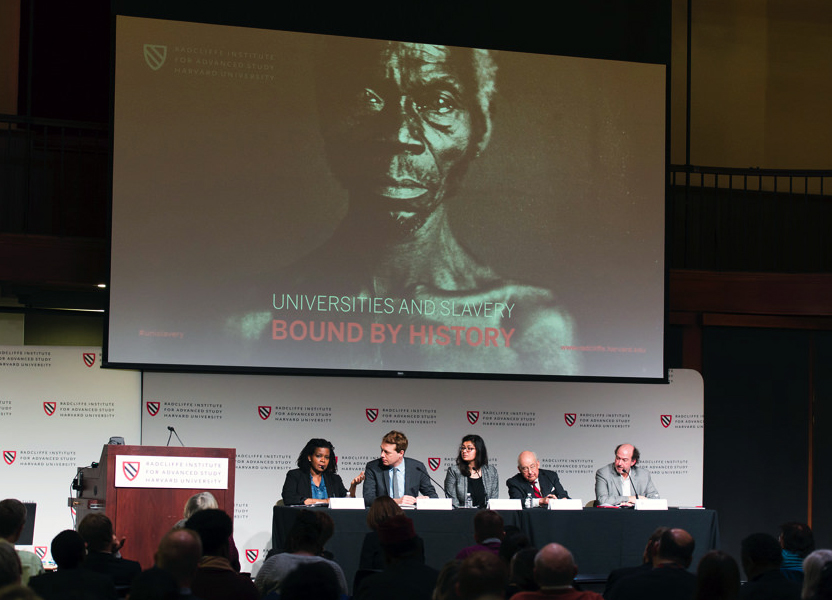
Universities profited from slavery and played a role in the enslavement of Black people. And it is time that they acknowledge this legacy and make amends for the harm they caused. Harvard University is the latest institution of higher education to address its role in slavery. The Ivy League university—with a massive $53.2 billion endowment—released a 134-page report on its legacy of slavery and announced a $100 million “Legacy of Slavery” fund to provide redress.
Among its findings, Harvard faculty, staff and leaders owned at least 70 people between the school’s founding in 1636 and 1783, when slavery was abolished in Massachusetts. These individuals had names such as Cicely, Titus, Venus, Violet, Juba, Dorcas, Guinea, Pompey, Hope and Bilhah, while others were known as “The Moor,” “The Spaniard,” “unnamed Negro boy,” “Young Jerry” and “the Negar.” Some of these enslaved people lived and worked on the Harvard campus and tended to the needs of Harvard presidents, faculty and students.
“Through connections to multiple donors, the University had extensive financial ties to, and profited from, slavery during the 17th, 18th, and 19th centuries,” the report says. “These donors helped the University build a national reputation, hire faculty, support students, grow its collections, expand its physical footprint, and develop its infrastructure.” Even today, Harvard honors benefactors with ties to slavery through buildings and professorships. Harvard also noted that some of its professors embraced eugenics, its museum has the remains of African and Indigenous people, and the legacy of slavery, segregation and discrimination lasted on campus well into the 20th century.
As a Harvard alum, I applaud the decision, which is socially responsible, if not a form of enlightened self-interest for the university. Colleges and universities produce the future leaders and thinkers, help to shape the direction of society, and have a great impact on the country. And while many of these institutions have benefited from Black labor and profited from the exploitation of their bodies, many of these universities were not originally intended for Black people—HBCUs notwithstanding, of course.
The University of Pennsylvania, where I received my law degree, found that while the university never owned slaves, at least 75 of its earliest trustees owned enslaved people, and faculty members and alumni were slaveholders, made Black folks three-fifths of a person in the U.S. Constitution, supported the Confederacy and promoted racial pseudoscience. Benjamin Franklin, Penn’s founder, owned slaves before becoming an abolitionist in his later years.
The University of Oxford, where I studied international human rights law, has established a scholarship program for Caribbean students. One of Oxford’s colleges was funded by a British sugar plantation baron and has a library named after him, while another college built a statue in honor of the colonizer Cecil Rhodes, who committed genocide against the people of southern Africa. And Rutgers University, where I teach journalism and media studies, acknowledged that it was founded by slaveholders and built by enslaved people of African descent. Rutgers has renamed campus buildings, including an apartment building that was renamed in honor of the abolitionist and author Sojourner Truth, who was owned by Rutgers’ first president.
Other universities have acted and made overtures to atone for their shameful past. For example, students at Brown University in Providence, R.I., voted overwhelmingly to have the school pay reparations to the descendants of Black people owned by Brown founders and former leaders.
Georgetown University—a Jesuit Catholic institution that sold 272 enslaved people in 1838 to stay financially afloat—pledged $100 million for a “truth and reconciliation” effort for the descendants of the enslaved.
The College of William and Mary formed a slavery reconciliation project with courses, research and symposiums, and the University of Virginia created a consortium of universities studying slavery after it released a report on its own involvement in enslavement. In the United Kingdom, Glasgow University pledged £20 million ($24.7 million) for restorative justice to address its financial gains from slavery. Meanwhile, the University of Cambridge formed a commission to study its ties to the trans-Atlantic slave trade, and the role of colonial-era racism in its scholarship. And the University of Bristol—whose crest features the slave trader Edward Colston and which depended on the slave trade for 85 percent of its wealth—has come clean on its past.
When Harvard and others announce their coming-to-Jesus moment on the sins of the past, we should not view this as the end of the story, but only the beginning. Hopefully, this will inspire governments, corporations and others to stand up, wake up and do right by the descendants of the enslaved.

The views expressed are the author’s own NOT necessarily AFRIPOL
Leave a Reply