
Sorting out my own grief over the death of Queen Elizabeth II, I feel some of what I imagine Frederick Douglass felt when he wrote his historic speech titled “What to the Slave is the Fourth of July.”
Douglass had escaped slavery to become a journalist, orator, statesman and friend of a president, Abraham Lincoln.
“This Fourth of July is yours, not mine,” Douglass told an abolitionist audience in 1852 a decade before the Civil War. “You may rejoice, I must mourn.”
That describes the divided tone of reactions to the death of the queen last week, at 96. For most Brits, by various news accounts, it was a genuinely traumatic event. I would venture to say the same is true, though perhaps with less trauma, for many of us Americans who, like me, grew up knowing no other British monarch.
Former Prime Minister Boris Johnson, a past and perhaps-once-again-future newspaper columnist, outdid most tributes in describing her in a speech as “the person who all the surveys say appears most often in our dreams.”
Yet, as with all matters of history, there is another side to this story, especially when it deals with history as vast and complicated as the British Empire.
One particularly inflammatory tweet from Uju Anya, a Carnegie Mellon University professor, went viral on the day the queen passed away.
“I heard the chief monarch of a thieving raping genocidal empire is finally dying,” the professor tweeted. “May her pain be excruciating.”
To call that harsh would be an understatement. By the time the tweet was removed by Twitter for violating platform policies, an online backlash erupted, including a response from Amazon founder Jeff Bezos.
But Anya justified the ill will as rooted in her “very painful” experience with the British colonial government overseen by the queen, if mostly symbolically.
“The harm shaped my entire life and continues to be my story and that of the people she harmed — that her government harmed, that her kingdom harmed, however you want to frame it,” Anya wrote.
While the United States was largely preoccupied with the Vietnam War, the ill-fated secession of Nigeria’s Biafra region killed more than 2 million ethnic Igbo people. The British government “wasn’t just in political support of the people who perpetrated this massacre; they directly funded it,” Anya wrote. “They gave it political cover and legitimacy.”
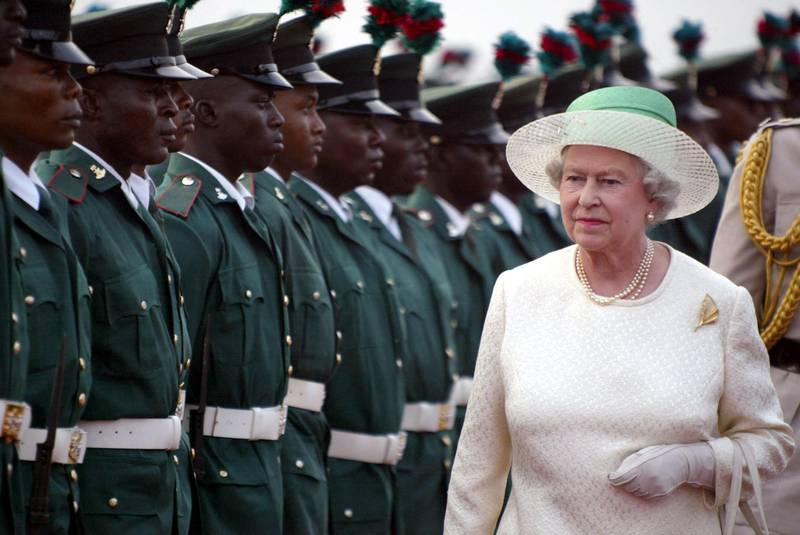
Anya was born in Nigeria to a Nigerian father and a mother from Trinidad and Tobago.
Britain colonized both countries. But Nigeria became independent in 1960, with Trinidad and Tobago following two years later.
But old colonial feelings and grievances die hard, if they die at all. As a new war of words breaks out between those who are outraged by Anya’s words and those who are outraged that her critics are outraged.
About 4,000 people reportedly have signed a petition defending the professor, in a matter that offers a small example in this former British colony of the larger challenges facing the monarchy at the end of the second “Elizabethan Age,” as some already are calling it.
It is the fortune, good or bad, of the new King Charles III to take the throne at a time when the monarchy still has widespread support, yet struggles to maintain its stature, especially among younger Brits.
Elizabeth actually came to power at a time when she oversaw the dismantling of colonialism, which continues today, mostly peacefully despite a history of violent conflicts from Africa to Asia and, let us not overlook, Northern Ireland.
In an age in which some Black Americans, with varying degrees of success have campaigned for reparations for slavery and Jim Crow segregation, it is not surprising that Britain and other former colonizers also wrestle today with what their forebears did. More folks than ever, it seems, are asking where the crown jewels came from.
What is the crown to today’s formerly colonized? Much the same message, I would say, that she expressed in her 1957 radio address:
“I cannot lead you into battle,” the young Elizabeth said. “I do not give you laws or administer justice, but I can do something else. I can give you my heart and my devotion to these old islands, and to all the people of our brotherhood of nations.”
It was a message with a power that sounded much more than symbolic. Her passing leaves her countrymen in an identity crisis, many say. But she did her best to assure us, as an old song goes, there’ll always be an England.
Clarence Page is member of Chicago Tribune editorial Board
Leave a Reply