
Written By Paul Nwabuikwu
In politics everywhere, one of the most important indices for measuring how much real influence a leader possesses is his ability to influence the process that determines his successor.
This is especially true in Nigeria, a society where everyone in authority is some kind of preening “chief” and the acquisition and deployment of political power is often crude and unsubtle.
In fact, the right to pick one’s successor has become some kind of tradition in our highly personalized political system in which institutions and norms are as feeble as the national electricity grid. At the state level, it is common for governors to routinely select one of their pliable minions and proceed to foist him on the hapless electorate as “the choice of the people”.
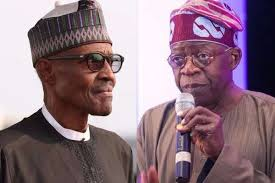
Against this background, the emergence of former Lagos governor Bola Ahmed Tinubu two weeks ago in Abuja as the presidential candidate of the ruling All Progressives Congress (APC) was solidly against the run of play.
The outcome of the event was not just the coronation of Tinubu as a master of realpolitik and one of the most successful godfathers in Nigeria’s history but also the resounding defeat of a sitting president who could not deliver one of the most basic testaments of power in the Nigerian system.
It is fascinating that Buhari, a soldier-politician known for his toughness and who, along with his tightly knit inner circle, had run a tight ship that ruthlessly controlled power for most of its tenure, was not able to choose his successor, something that most persons in elected executive positions take for granted.
His failure to do so speaks volumes about the man, the limitations of his personal style, his insular political network and, of course, his government which reflects these attributes and limitations. Buhari’s loss also reflects the impact of the absence of his first chief of staff Abba Kyari and other deceased associates who provided the strategic political support that made the government a feared and formidable force in its early years.
Buhari’s failure is a clear contrast from the record of the only other Nigerian leader to complete two terms – Olusegun Obasanjo – who singlehandedly picked Umaru Musa Yar’Adua, a reticent sickly governor and largely unknown quantity, and made him president.
The eventual outcome of the APC convention is significant because Muhammadu Buhari didn’t want Tinubu to replace him as APC candidate and ultimately, next occupant of Aso Rock. It was clear from the trend of events before the event and the frenzied last-minute politicking. Based on the signals coming out of the Villa, most pundits did not see Tinubu’s victory coming. When Senate President Ahmed Lawan from Yobe State in the North East was trotted out in the final hours as “Buhari’s choice”, it was seen by many as the final nail in the coffin of Tinubu’s ambition. The North East and South East are the only zones out of the six that have not produced a civilian president so far and so it seemed like a smart geopolitical strategy. To further boost his perceived chances, Lawan was the choice of the President’s close relative and powerful senior member of the “cabal”, Mamman Daura.
But as things turned out, Lawan made hardly a dent on the Tinubu behemoth which crushed all opposition on its way to a landslide victory. His final vote tally – 1271 – was over quadruple the votes of Transport Minister Rotimi Amaechi who was second. The scale of his victory at the APC convention despite not being the president’s choice underscores the weakness of Buhari within his own party.
The pre-Convention opposition to Tinubu was understandable. Among other issues, he was considered too rich and too powerful to be trusted with power. It was a conclusion that Tinubu who ruthlessly controls Lagos politics would have appreciated. In the grubby tradition of Nigeria’s politics, a loyal lackey is always seen as a safer option. But in the end, the opinion of Buhari and those opposed to Tinubu did not matter.
As Tinubu, hands shaking, lifted the party’s flag high after his landslide victory, the Buhari myth of toughness was heading in the other direction. The president’s strong grip on power was officially over. Buhari’s most powerful days as president are behind him and there is absolutely nothing he can do about it. Tinubu had beaten him both within his political stronghold in the far north as well as the other power centres of the APC party. The routing was comprehensive.
How did this happen?
Well, to some degree, the weakening of presidential influence in the last days of an administration is inevitable. No leader, however powerful, can resist becoming a lame duck as the clock on his time in the saddle runs out. Ordinarily, the lame duck period should kick fully in after the election of a successor. But it seems to be happening faster in Buhari’s case because of his personal weaknesses as a leader.
No doubt, there are other important immediate factors that contributed to Tinubu’s victory. The decision of the northern governors to ignore the president and the cabal and back a southern candidate was critical. So was Tinubu’s early start and his formidable political network supported by the largest war chest in Nigerian politics and guaranteed by a blank cheque from the Lagos treasury. No other candidate could compete.
But in the end, the weaknesses of a constitutionally powerful but politically ineffective president made Tinubu’s coronation a fait accompli.
Outside his narrow inner circle, the president does not have much personal goodwill. His taciturn style, a perception of lack of empathy, a widespread belief that he does not care much about his troops including those who supported him at great personal cost may dog his final years in government and his retirement years which, according to a northern friend, will be very lonely.
Buhari enjoys the ceremonial aspects of power, the pomp and perks of office but lacks the personal touch and charisma to inspire loyalty beyond the call of duty in his last days in office. He may not be able to count on the loyalty of the many unhappy “godsons” who believed they had presidential endorsement for their aspirations before the convention.
Every leader recreates his govt in his own image. Buhari is a rather stiff, even shy man with few real friends so his government has been quite an insular one. And that insularity and the depleted ranks of trusted associates is the reason Tinubu, who is his exact opposite, is today the APC candidate.
Leave a Reply