
Written by Chanda Chisala
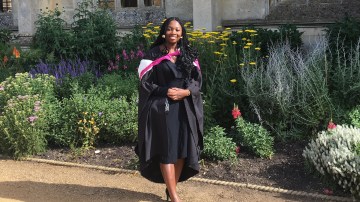
Chidera Ota, University of Cambridge
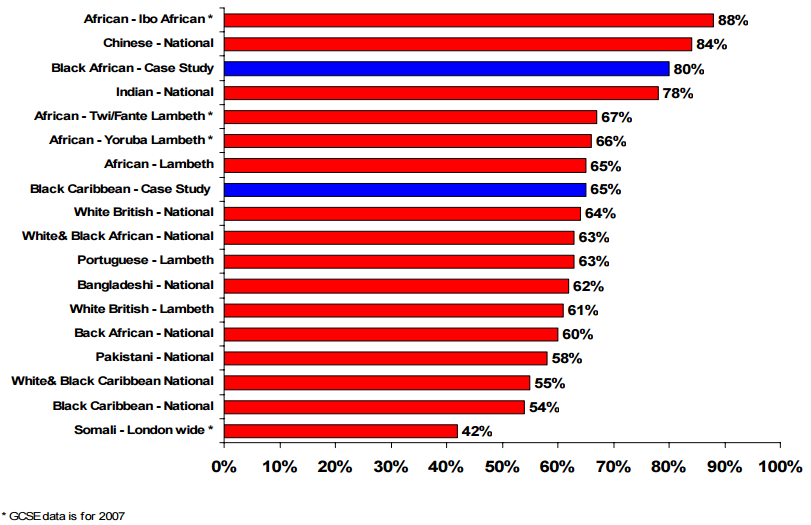
Source: Raising the Achievement of Black African Pupils: Good Practice in Schools
A couple of years after that news and more stories of black and other minority progress on GCSEs, GL Assessment, an independent testing organization, published results of their Cognitive Assessment Tests (CAT), indicating the performance of different ethnic groups. The CAT, though given to children at age 11, is highly correlated with GCSE results at age 16. The CAT results confirmed what the GCSEs had shown: that black Africans were catching up with British whites, and this sparked even more panic in the IQ-human biodiversity blogosphere.
Nigeria and Igbo academic supremacy in Britain
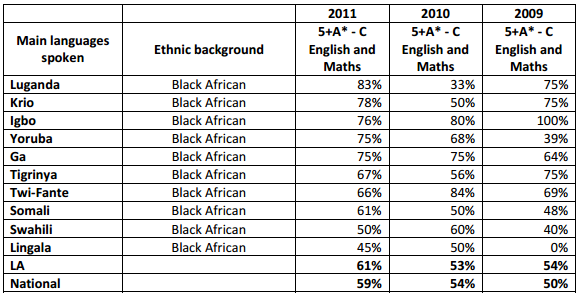
Although the Chinese and Indians are still very conspicuously above even the best African nationalities, their superiority disappears when the Nigerian and other groups are broken down even further according to their different tribal ethnicities. Groups like the famous Igbo tribe, which has contributed much genetically to the African American blacks, are well known to be high academic achievers within Nigeria. In fact, their performance seems to be at least as high as the “model minority” Chinese and Indians in the UK, as seen when some recent African immigrants are divided into languages spoken at home (which also indicates that these are not multigenerational descendants but children of recent immigrants).
Africans speaking Luganda and Krio did better than the Chinese students in 2011. The igbo were even more impressive given their much bigger numbers (and their consistently high performance over the years, gaining a 100 percent pass rate in 2009!). The superior Igbo achievement on GCSEs is not new and has been noted in studies that came before the recent media discovery of African performance. A 2007 report on “case study” model schools in Lambeth also included a rare disclosure of specified Igbo performance (recorded as Ibo in the table below) and it confirms that Igbos have been performing exceptionally well for a long time (5 + A*-C GCSEs); in fact, it is difficult to find a time when they ever performed below British whites. The Chinese and Indian levels of Free School Meals are even lower than the Ghanaian and Nigerian pupils when the Africa segment is broken down into nationalities.
If these Nigerian groups really performed so well under the years in question when the media started catching the news, one would expect some names of their students to be reported in the news among the best performing students in the country. Statistically, if girls outperformed boys and Igbos outperformed other ethnic groups in 2010, one would expect an igbo girl to be among the top performers in the country. In fact, according to a Daily Mail report on the GCSE results of 2010, the best student in the whole country was indeed a Nigerian girl, Chidera Ota. A check on Nigerian names confirms that she is of Igbo descent. Ota scored 15 A*s, higher than any Chinese, Indian or white student, and higher than any student from prestigious elite schools like Eton College (she was at a state funded selective high school for girls).
To put it into perspective, these results mean that the children of black Africans (or at least West Africans) are not only not scoring below the scores of low-IQ poor white children, as Jensen’s calculations would predict, they are even able to score above children of elite whites too (who go to Eton college etc).
What are the chances of a girl from a small minority group of immigrants whose home country is 2 standard deviations below the host country’s mean IQ achieving the best academic results in the host country? If the average IQ of SubSaharan African adults is equal to 11 year old Europeans, as their IQ scores estimate (Rushton, 2004), what are the chances that an African child of such adults would ever beat all European children in academic achievement? Had the low phenotypic IQ of black Africans truly been biologically caused even to some degree, such feats should be as rare as having the fastest 100 meters runner in the world coming from the slowest running ethnicity in the world. In short, what are the chances of say, an Indian immigrant to Jamaica winning the national 100 meters sprint? Even more incredible, what are the chances that the children of such “super-selected” Indian immigrant athletes would also (on average and on top) beat the children of native Jamaicans and other immigrants known for their superior athleticism?
The academic performance of the African students in the UK is even more remarkable when the well-known fact of higher black involvement in sport and athletics (at any level) is taken into account. Whereas Chinese and Indian students are not exactly expected to lead their schools or colleges to winning athletic championships, many black students are actively involved in athletics even when they have a strong academic focus. For example, a check on the Cambridge web site reveals that Chidera Ota, the UK’s best GCSE student in her cohort, was also the fastest runner in the girls 100 and 200 meters team for Cambridge (she qualified to Cambridge’s premed program after subsequently achieving straight A’s on her A-levels).
Since she could not have just become a fast runner in college, it means that she achieved her academic performance in high school while being very active in athletics. It is quite plausible that the higher athletic commitments of black African students probably hinders them from achieving even further than they do in academics; it is especially difficult to develop a deep mastery of a specific academic field since this requires much more intensive focus and time commitments. On the other hand, it is also difficult for them to suppress their natural athletic (or artistic) gifts and interests for an unbalanced academic existence.
Chanda Chisala, excerpts from his essay “The IQ Gap Is No Longer a Black and White Issue” Chisala has been a John S. Knight Visiting Fellow at Stanford University, a Visiting Fellow at the Hoover Institution, and a Reagan-Fascell Fellowship at the National Endowment for Democracy.
Data from the national pupil database shows that pupils who speak Igbo [one of four official Nigerian languages] have a GCSE pass rate 18 percentage points higher than the national average; black Portuguese speakers have a rate less than half the national average.
AI Overview
Igbo students in the UK generally show strong academic performance, often exceeding the national average for GCSE pass rates and attainment in other key measures. Data indicates that Igbo students have a high GCSE pass rate, significantly above the national average. Additionally, Black African students, which includes Igbo individuals, tend to perform better than Black Caribbean students.
Elaboration:
- Strong Performance:
Schools Week reports that Igbo students have a GCSE pass rate 18 percentage points higher than the national average.
- Exceeding Averages:
Lambeth Council indicates that Black African students, including those who speak Igbo, surpass national averages in achieving grades 9-4 in English and Maths.
- High Attainment 8 Scores:
GOV.UK shows that Black African students, including Igbo, achieve high Attainment 8 scores.
- Outperforming White British Students:
While many ethnic groups outperform White British students, Black African groups, including Igbo, have consistently achieved higher GCSE grades than White British students, GOV.UK reports.
- Positive Outcomes:
Black African pupils, including those who identify as Igbo, generally fare better than Black Caribbean pupils.
- Supportive Environments:
International schools and universities in the UK provide international students with strong academic support systems and resources, such as personalized attention, mentorship, and access to libraries and technology Abbey DLD Group of Colleges, aecc Nigeria.
Leave a Reply