
BAGHDAD — Randa Abd Al-Aziz was relaxing in a Baghdad cafe, making her friends laugh by reading a cosmetics pamphlet aloud in classical Arabic, the exaggeratedly formal language of speeches, official decrees — and TV anchors.
Overheard by a talent scout, Abd Al-Aziz soon got a totally unexpected and life-changing offer: How would she feel about reading the news on television?
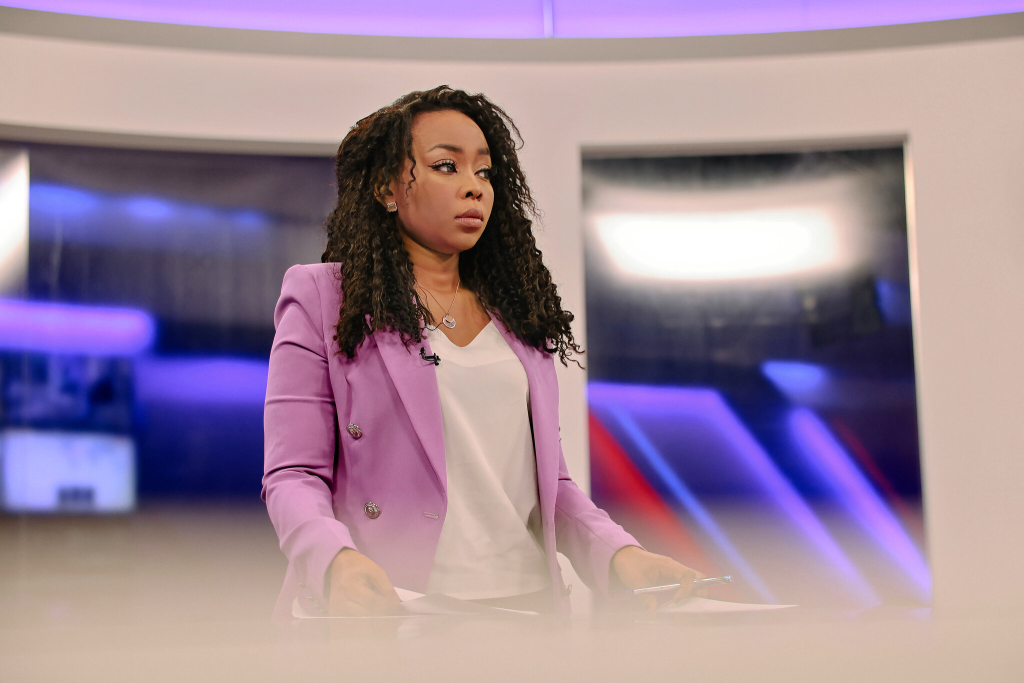
Abd Al-Aziz recounted the story of her discovery as she was getting ready for a recent broadcast. She tilted her face so a makeup artist could apply the armorlike layer of foundation and eye makeup that transforms what she describes as her “baby face” into that of a sophisticated anchorwoman, one who is not just presenting the news but also making Iraqi history.
Abd Al-Aziz, 25, is the first Black Iraqi employed on air at the state television’s news and information channels, at least since the United States toppled Saddam Hussein almost two decades ago. (TV executives said they believed there had been no Black state TV anchors during Saddam’s decadeslong rule, either.)
“I thought it would just be for a few days, and they will see it won’t work, and I will leave,” said Abd Al-Aziz, who had no previous TV experience and only a passing curiosity about the news media. She took her mother to the initial meeting with the network.
Abd Al-Aziz’s journey from a cafe to the anchor chair was a hard road, with more than six months of 10-hour days of voice lessons and an immersion into Iraqi and regional politics, topics in which she previously had zero interest.
“I worked on it. I worked on my voice, took time to follow the news,” she said, adding that she learned from every negative comment her tutors gave her. “This is what made me progress.”
On a recent morning, she arrived early at the studio, picking up her scripts for the main noon newscast and reading them over before she slid with obvious confidence into a chair in front of a teleprompter.
The ease she feels now is a far cry from her first live bulletin in September when she said she was frozen with fear.
“I didn’t make a single mistake, but when I got off air, I burst into tears,” she said.
Her hiring last year came after a nationwide search by the head of state media, who added her to the network’s roster of about 100 news anchors, correspondents and show hosts.
“We have in Iraq at least 1.5 million African Iraqis,” said Nabil Jasim, 51, the president of the Iraqi Media Network. “They need to see themselves reflected on TV.”
Her hiring shocked and bothered a few network employees and viewers, Jasim said, a negative response that highlights the deeply entrenched racism in Iraq, a country with about 40 million people.
In the country’s tribal-dominated political system, Black Iraqis have essentially no political representation. Iraq’s Parliament does not have a single Black lawmaker. There are almost no senior Black officials in government ministries. As in other Arab countries, many Iraqis casually use racial slurs.
Most members of Iraq’s Black community are descendants of enslaved East Africans taken to the southern coast of Iraq beginning in the ninth century, a slave trade that lasted more than 1,000 years and that ended in some Arab countries just decades ago.
In Iraq, the slave labor was concentrated in the south, where there was backbreaking work in salt fields and date plantations. Most of Iraq’s Black population still lives in the county’s south in intense poverty and with little formal education.
Abd Al-Aziz’s background is atypical for a Black Iraqi: She grew up in a middle-class family in Baghdad, where her late father was a businessman and her mother now owns a stationery shop. Abd Al-Aziz earned a degree in agricultural economics and was working in an import distribution business when the network approached her.
Even though she was hesitant, the recruiter convinced her to take the chance.
“He told me there’s an experiment, that they wanted to see all colors on Iraqiya TV,” Abd Al-Aziz said, referring to the state broadcaster, which a Baghdad University poll found to be the most widely watched of Iraqi networks. The network has Turkmen and Kurdish and Syriac channels, in addition to its mainly Arabic-language programming.
Abd Al-Aziz said she first had to persuade her mother to agree, and then she accepted the offer, thinking she might last a week before the network realized she could not do it.
“At the beginning, they said, ‘There is no hope for her,'” Jasim said, describing the reaction of producers assigned to work with her. “I said, ‘Just put her in front of the camera and leave the rest to us.'”
In a profession that relies heavily on physical appearance, he was sure Abd Al-Aziz had the right look for television. And the networks’ producers came to agree with their boss: The camera loves her.
Usually when Black Iraqis appear on television, it is as musicians, dancers or in comedic roles. Jasim said he wanted to dispel those stereotypes and was considering a political program for Abd Al-Aziz to host.
While the Black Lives Matter movement has spread across much of the world, Iraq has only a nascent Black rights movement.
There is no consensus among Black Iraqis even of what to call themselves. Some reject the terms Black or African Iraqi as divisive. Many have settled on the Arabic term “asmar,” or dark-skinned.
Asked what she considers the best term, Abd Al-Aziz said, simply, “Iraqi.”
“Iraq is diversity. We have more than one origin. Your nationality is enough,” she said.
Abd Al-Aziz was the only Black student in her class at high school, but she said she did not feel a lack of opportunities growing up. Asked about the discrimination faced by the broader Black community in Iraq, she said she did not yet know enough to feel comfortable commenting.
“I like to talk only about what I have witnessed myself,” she said. But, she added, she was determined to learn more.
“Before, I had no interest in the political reality,” she said. Now she is asking questions about race and power in Iraq.
If Abd Al-Aziz has not felt blocked by racism, it has held back hundreds of thousands of other Iraqis.
Slavery was officially abolished in Iraq in 1924; in Saudi Arabia, it was 1962. In Oman, slavery was legal until 1970. Across the Arab world, Black people are still commonly referred to as “abeed,” meaning slaves.
While the word also refers to servants of God and is part of many Muslim names, its use to describe a Black person is offensive.
“Other Iraqis deal with us as if we are still slaves,” said Abdul Hussein Abdul Razzak, a Black journalist and the co-founder of the Free Iraqis Movement, an association started in 2017 to defend the rights of Black Iraqis.
Despite years of writing for government newspapers as a freelancer, Abdul Razzak, 64, said he had never been employed by any of them.
“I am a good journalist, but no one ever gave me a chance to work,” he said.
Black rights advocates say many Black students drop out of school because of bullying by students and teachers. A survey in 2011 reported illiteracy rates among Black Iraqis at 80%, a figure more than twice as high as the national average and believed to be largely unchanged since then.
“My aunt could not read or write, but she used to tell me that our school diplomas would be the weapons in our hands,” said Thawra Youssif, a Black Iraqi who lives in Basra, Iraq’s second-largest city.
Youssif, 62, who has a doctorate in theater, said she is one of only a handful of Black Iraqis in Basra with a postgraduate degree.
“If you asked them about Malcolm X, no one will know him,” she said. “If you cannot read, you cannot search the internet to know your roots. My people need to be educated to overcome the legacy of enslavement.”
Having mastered television, Abd Al-Aziz said she is now slowly growing into the idea of being a role model who could inspire Black Iraqis.
“I am trying to demonstrate that my example can be a hope for everyone,” she said. “That the color of our skin will not stop us.”
Credit: New York Times
Leave a Reply