
Nigerian Bishop Dunia appeals for peace and international support as communities in his country continue to face relentless violence and displacement.
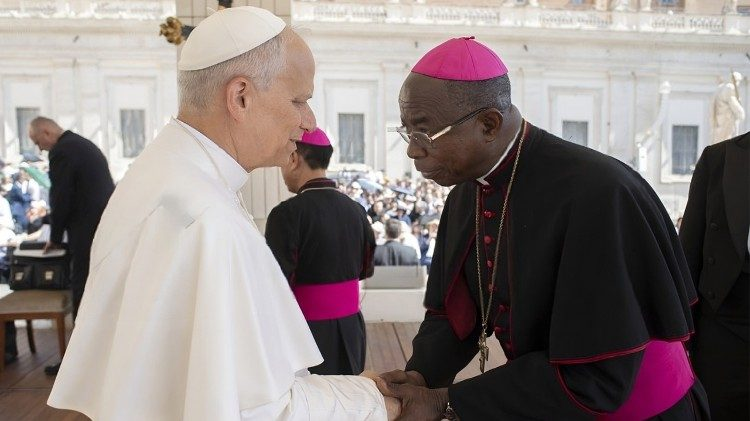
by Vatican News Francesca Merlo
The surge of violence in Nigeria has been a cause for concern for many years, with armed groups attacking villages and homes, kidnapping and often killing people. At times, the attacks appear to be due to religious or ethnic differences, other times, there seems to be no motive behind the senselessness.
Pope’s closeness
Pope Leo recently prayed for the people of Nigeria during his Sunday Angelus on the 15th of June. Shortly after 200 people were killed in a brutal attack in Benue State, the Pope prayed for “security, justice, and peace” in Nigeria, adding that he was thinking in particular of the “rural Christian communities of the Benue State who have been relentless victims of violence”.
Bishop Gabriel Dunia of the Diocese of Auchi in Nigeria welcomed Pope Leo’s recent call for an end to violence in the country. He described it as a clear sign that “people care” and that Nigerians are not alone in their suffering.
Bishop Dunia explained that there is no single explanation behind the violence. “Some believe it is ethnic, others say it is religious, or about taking land. What is clear is that they use the ransom money to fund whatever they are planning”.
Constant attacks
Speaking about the situation in his diocese whilst on a visit to the Vatican, the Bishop described a climate of insecurity marked by frequent and unpredictable attacks. “The bandits, often referred to as Fulani herdsmen, are everywhere,” he said. “They attack on farmlands, on the roads, and even inside homes. People are being taken into the bush. Some are killed. Some are released after ransom is paid – even by families who can hardly feed themselves.”
The attacks themselves are often marked by extreme brutality. Survivors speak of homes set ablaze in the middle of the night, entire families killed in their sleep, and women and children taken hostage. Villages are razed, crops destroyed, and livestock stolen, leaving survivors with nothing to return to.
Often, attackers arrive on motorcycles, heavily armed and dressed in military-style uniforms, making it difficult to distinguish them from actual security forces.
These attacks, said Bishop Dunia, “are not random”, but rather “they are methodical acts of terror designed to erase communities and sow fear”.
Bishop Dunia also expressed concern about the influence of Boko Haram. “Some of those said to have repented have infiltrated security forces. We cannot trust that the people sent to protect us are not involved in these attacks”.
Fear, he said, has become a part of daily life, so present and fierce that it has become like “a sickness”.
Attacks on churches
The bishop emphasised that despite the numerous attacks on churches and church personnel, vocations continue. “The young people still have hope. They are not giving up. They want to keep going”, he said. The bishop recalled the kidnapping of a major seminarian and a priest in February. “The priest escaped, but the seminarian was killed”. And just two weeks ago, a minor seminarian, too, was kidnapped from his home, and his younger brother was shot.
“We are still waiting to hear if a ransom will be demanded”, said the Bishop, explaining that in view of these attacks, the diocese has hired private security to guard the seminary because state forces are overstretched.
He shone a light on the brutal reality that even when hiring private security, the police ask for money.
Displacement
Entire communities have been displaced, forced to leave behind their homes, fields, and churches. Many now live in camps for internally displaced persons, which are often overcrowded and under-resourced.
Bishop Dunia noted that families have had to flee multiple times, and often find themselves in unfamiliar towns or cities with no means to support themselves. “Some of the people in our care have seen their homes destroyed not once, but three or four times. Each time they begin to rebuild, the violence returns”.
Response of the diocese
Despite limited resources, the diocese continues to respond as best it can. “We hold meetings. We ask people to be vigilant. We encourage them to accompany each other during daily tasks and to be alert”. The bishop also stressed the need for better support from the government. “Local security people don’t have the weapons to confront these attackers, who come with heavy arms”, he said.
Bishop Dunia stressed that his governor has shown support. “He told me he would not allow his citizens to be massacred”. However, the Bishop also pointed out that the broader situation is fragile and unclear. “We don’t know how sincere some government officials or businesspeople really are”.
To young people and to the world
To young people living in fear, Bishop Dunia urged caution but also resilience: “Be bold, be courageous, but be aware. Be conscious of your surroundings.”
“If the government cannot handle this, they should ask for help”. Thus, to the international community, Bishop Dubia asked for assistance. “Not just in words, but in action”. Finally, he stressed, “We cannot manage this alone”.
Leave a Reply