
Written by Peter Dizikes | MIT News Office
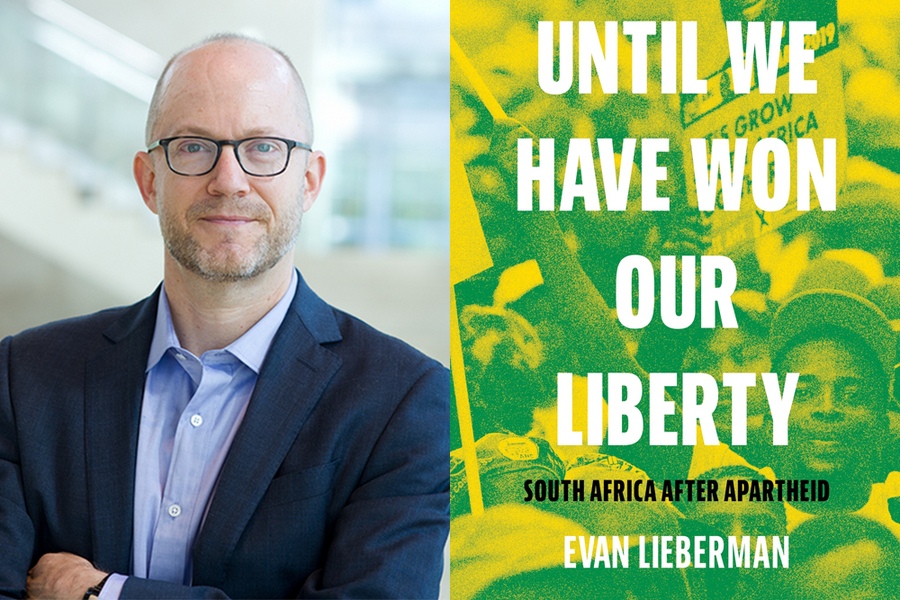
In a new book, MIT political scientist Evan Lieberman examines a quarter-century of post-Apartheid government and finds meaningful progress.
Back in April 1994, the world watched a remarkable event: South Africa’s first democratic election with universal suffrage. The country whose Apartheid system had legalized racial segregation since the late 1940s went to the polls and elected a new national assembly. In turn, that assembly picked a Black president: Nelson Mandela, who, after decades in prison, became the South Africa’s new leader.
Those events were a major part of the global 1990s-era shift toward democratic rule. But in recent years, critics have increasingly questioned the success of South Africa’s democracy, citing uneven economic development, malfeasance, and more. One post-Mandela president of South Africa, Thabo Mbeki, notoriously doubted the links between HIV and AIDS, exacerbating a health crisis in the country; another, Jacob Zuma, was beset by multiple corruption charges.
Today, with democracy being threatened in many countries around the world, the stakes seem higher than ever for a clear-headed assessment of the South African experiment. And MIT political scientist Evan Lieberman, a career-long scholar of the country, thinks South Africa’s quarter-century of democracy has been a success. Despite various setbacks, Lieberman contends, the government has delivered material gains while ensuring rights and liberties far beyond what most people could have imagined 30 years ago.
“The most unjust society on the planet was South Africa,” Lieberman says. “How did this get fixed? With a democracy that’s open to people of all races.”
Now Lieberman makes that case at length in a new book, “Until We Have Won Our Liberty: South Africa after Apartheid,” which will be published in June by Princeton University Press. (The title refers to a phrase from the 1955 “Freedom Charter” backed by the country’s best-known anti-Apartheid group, the African National Congress.)
In the book, Lieberman contends that South Africa has successfully pursued “dignified development,” material growth along with a respect for the rights and inherent equality of people; and, despite the foibles of some corrupt officials, has been building a robust set of democratic practices, in stark contrast to the Apartheid era.
“We can acknowledge the problems but also highlight the fact that so much has gone right,” Lieberman says. “If we fail to appreciate that, then we’re missing some really important things,” he adds. This includes “overall levels of service provision, the function of democratic practice, and the civil exchange of ideas,” all things Black South Africans had largely been denied before the 1990s.
“To me that’s the big picture of this incredible story that is so important,” Lieberman says. “There is a vast improvement in how things were, which has been obtained through democratic measures.”
On the ground in Mogale City
“Until We Have Won Our Liberty” does not entirely have the typical form of an academic book. In it, Lieberman interweaves a reporting narrative from the eve of South Africa’s 2019 elections, talking to citizens in Mogale City municipality, centered in the midsize gold-mining city of Krugersdorp, where he was doing research.
“I wanted to see what I could learn and how well I could capture what was happening along the way,” Lieberman says. “I thought this would be a nice way for readers to see what I saw.”
As it happens, in 2019 the African National Congress (ANC) — the party descended from the Apartheid-era opposition group — retained power but with a narrowed majority. As Lieberman details in the book, there is plenty of discontent on the ground with the ANC. In one survey Lieberman conducted in Mogale City, near Krugersdorp, 55 percent of whites said life was worse today than in the Apartheid era — but 50 percent of Blacks, did, too.
To an extent, Lieberman notes, that level of sentiment is partly explained by a widespread human tendency to be nostalgic about the past. More broadly, it may speak to the way democracy can suffer from an expectations problem.
“It’s easy for everyone everywhere to look back on the past with rose-colored glasses,” Lieberman says. “I think particularly in recently democratized countries, there’s a pervasive problem of democratic disappointment — which is that there’s a buildup of expectations that a major change in regime is going to change everything.”
Black South Africans have in general not caught up to the European-level standard of living that white South Africans have long enjoyed. But progress is demonstrable in other ways. In 1996, only 58 percent of South Africans had access to electricity. Today, 90 percent of South Africans are on the grid. There have also been substantial gains in access to housing, water, refuse removal, and more.
Moreover, Lieberman says, a substantial part of dignified development “is not just about economic growth, but about being treated like humans in everyday life,” where he believes South Africa has performed well.
“Political parties organize and compete for power, people vote, the allocation of power reflects those votes, and people are free to speak their voices,” Lieberman says. “When the government does something wrong, lawyers can take the government to court, and the court frequently rules against the government, and the government has to comply. That’s democracy working, and it’s what we hoped for, that this society might have that, rather than what they had before, which was racial oligarchy where a small minority of white people ruled.”
Curbing inequality and violence
Still, as global events in recent years have shown, democracy, once constructed, does not always remain standing. If South Africa has had a successful 25 years (as of the 2019 elections) of democracy, what factors are most crucial in ensuring another 25 years of democratic rule?
“The biggest threats to democracy [in South Africa] are profound inequality and the tendency to resolve disputes and frustrations through violence,” Lieberman says.
On the first point, he adds, “I think much more has to be done, not just through the public sector, but through the private sector, to improve opportunities for material gain.” On the second matter, he observes, “the propensity for people to resolve disputes through violence is really troubling, [and] one thing I would hope to consolidate through democracy would be a reduction of [that]. Overall there’s been a significant reduction in violence, compared to the 1980s and 1990s in South Africa — but there have been some upticks that are troubling.”
Other scholars say “Until We Have Won Our Liberty” is an important contribution to both political science and recent political history.
Daniel Ziblatt, a professor of political science at Harvard University, has called the book an “evocative personal narrative and judicious empirical analysis,” leaving readers with not only “a new appreciation for the momentous accomplishments of post-Apartheid South Africa, but also with a moving and powerful defense of democracy’s enduring value.”
For his part, Lieberman hopes readers will both absorb the substantive case for regarding South African democracy as a success, while also considering that speaking up about the value of democracy is a part of sustaining it.
“In some ways, that’s one of the hopes for the book,” Lieberman says. “It’s not an A+ report card for South African government. It’s not saying government officials have all acted well or citizens have all acted well. But it’s trying to recognize the fact that this democratic experiment has gone very well. Lots of people have worked hard to build a better life and society out of a very divided past. I hope those who risked their lives [and] resisted the temptation to enrich themselves will take some comfort in having someone acknowledge that their work is not for nothing, and should be recognized.”
Leave a Reply